General Assembly Product Management Certification Project · 2024

Clean Plate Club

Background

Food waste is a chronic, expensive problem in most households – the average American throws away 30-40% of the groceries they buy. This isn't from carelessness but from the difficulty of consistently knowing what's on hand and what's about to go bad.

Solution

Clean Plate Club is an app that reduces household food waste by giving users real-time visibility into their food inventory and when it will expire. This project was developed for a product design certification, which emphasized evaluating feature viability and behavior change, so I approached each decision with an eye toward whether it would actually be worth building.

In this case study, I show how I designed a system that shifts users from reactive cleanouts to proactive food use.
Problems

As defined by interviews and field studies with 8 users.

1.

Users struggle with seeing and knowing what they have, leading to overbuying, duplicate purchases, and items forgotten at the back of the fridge or pantry.

2.

Users don't fully understand their food's expiration dates and freshness timelines, leading to food spoiling quicker than expected.

3.

Without visibility into freshness, users' habits were reactive rather than proactive (i.e., spoiled food was typically discovered during a cleanout, after it was already too late to use).

Approach

Interviewees described a mismatch between what they thought was in their kitchen and what actually was, which consistently led to overbuying and spoilage. In field studies, participants were frequently surprised at finding items they didn't know were there, as people in their household - or they themselves - moved items around daily.

Methods

  • Interviews with 8 users on values, motivations, and food-management routines
  • Field studies with 2 participants, food shopping with them and observing how they sorted their fridges/pantries after purchase
  • Competitive analysis of the tools participants already use for meal planning

Opportunities

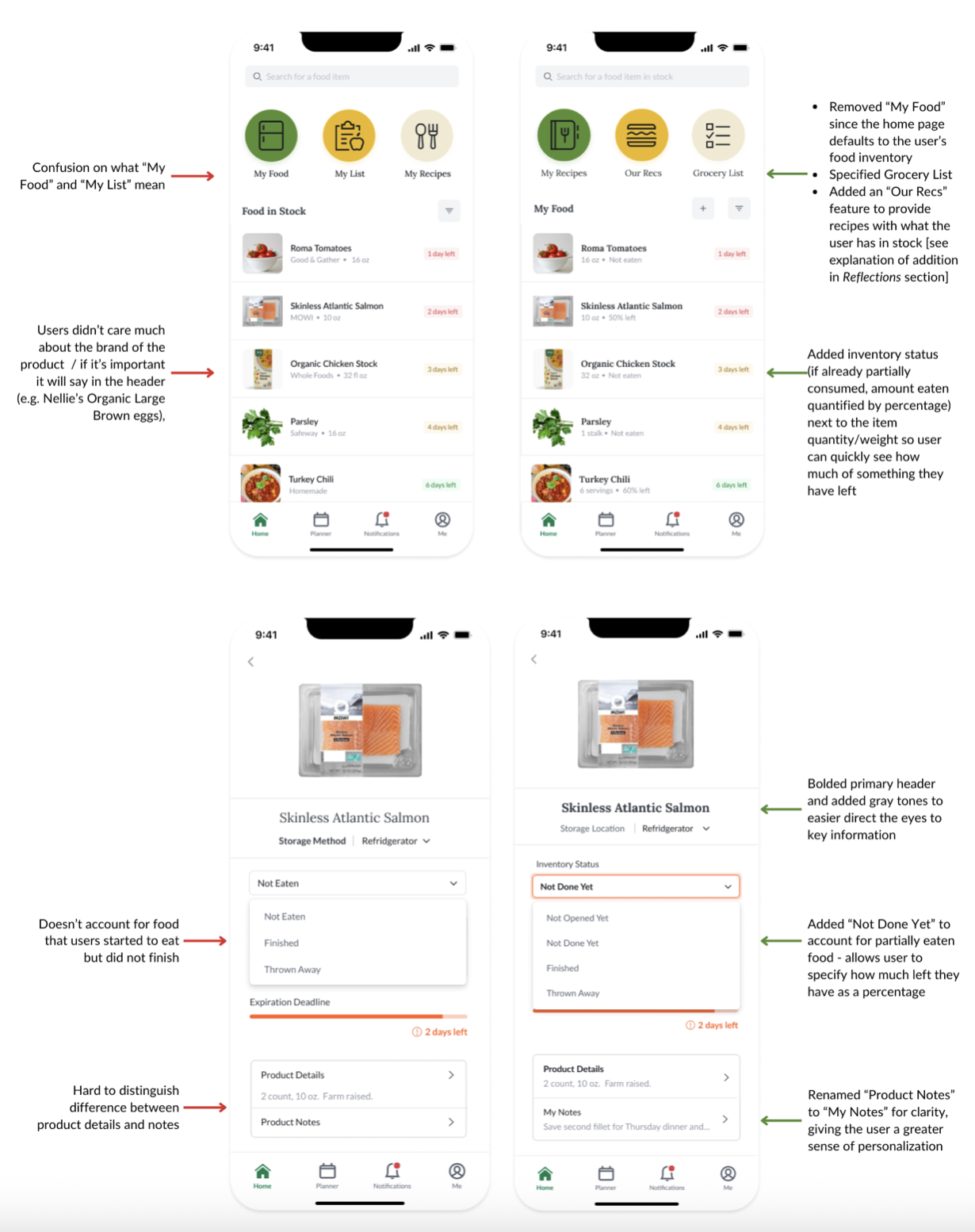
  • Photos of the food item are shown next its name, including brands or personal images
  • The app proactively adds items to a user's inventory after they check it off their grocery list, removing the manual entry burden that makes most tracking apps fail to stick
  • Their food inventory list defaults to sorting by time to expiration, with filters (e.g., food type) so users can personalize the view to how they think about their food

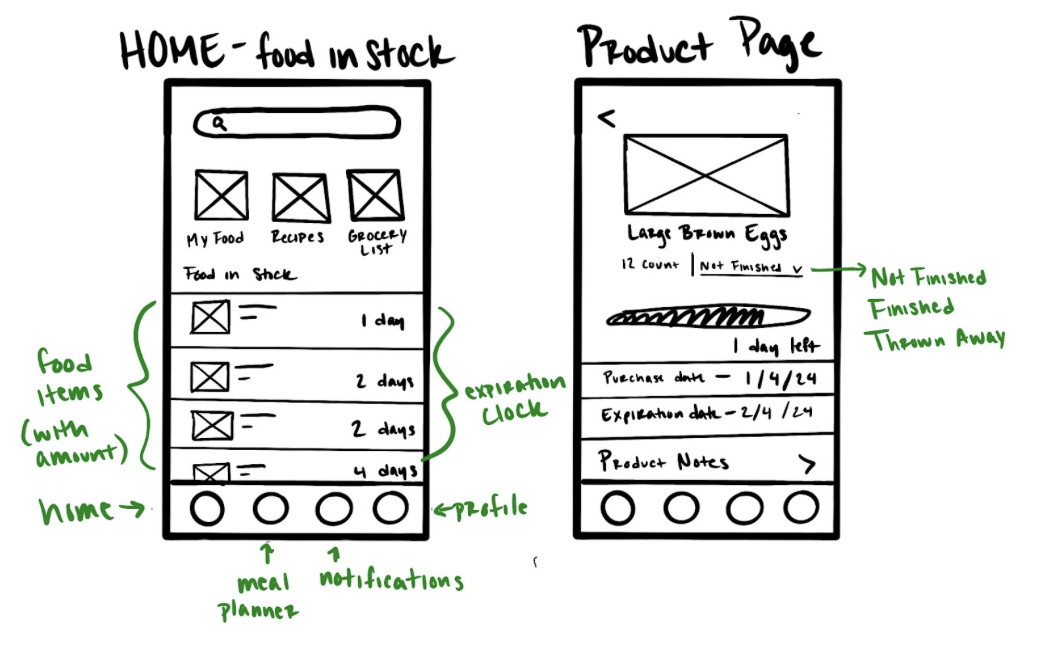
Initial sketches of inventory (home) page and food item (product) page

Users frequently reported food going bad faster than expected, mostly because they didn't know the best-by date or expiration timeframe.

Methods

  • User interviews focused on how people currently judge whether food is still good, such as what cues they rely on (smell, appearance, printed date, instinct) and where that breaks down
  • Improvement: It would have been interesting to do a diary study asking 3 to log what they throw away over 1–2 weeks and why, which would service exact patterns in what expired unexpectedly and what "expiration" meant to them

Opportunities

  • Color-coded visual system so freshness status is scannable
  • Food-specific freshness estimates: the app calculates an adjusted "best by" window based on food category, storage location, and purchase or open date, rather than relying solely on package labeling that may be absent (produce, leftovers)
  • Improvement: Plain-language freshness staging instead of time to expiration (e.g., Fresh, Use within a week, Use today, Past peak) replacing binary good/expired framing that doesn't match how food actually degrades

Usability testing findings on expiration and consumption communication

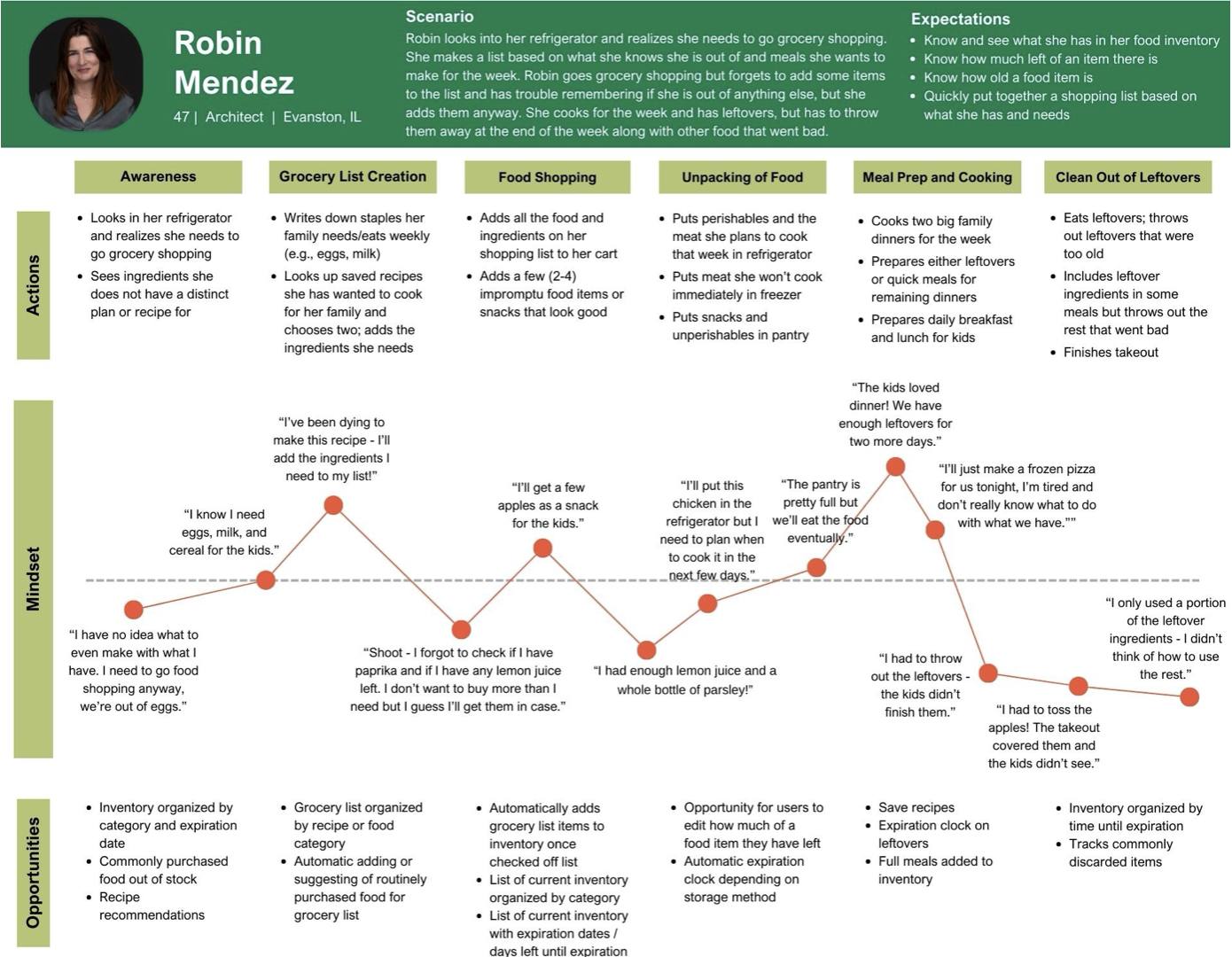
Journey mapping showed that spoilage was almost always discovered too late, such as during a cleanout, rather than caught while the food was still usable.

Methods

  • Persona creation and journey mapping to pinpoint where friction occurred across a week of buying, consuming, and discarding food
  • Field studies watching how and when 2 participants checked food status in their normal routine, revealing the reactive habit is about lack of a visibility and trigger

Opportunities

  • Notification center for food close to expiratoin, nudging consumption before spoilage (improvement: test timing and framing of notifications, since poorly timed or overly frequent notifications can just get ignored or turned off)
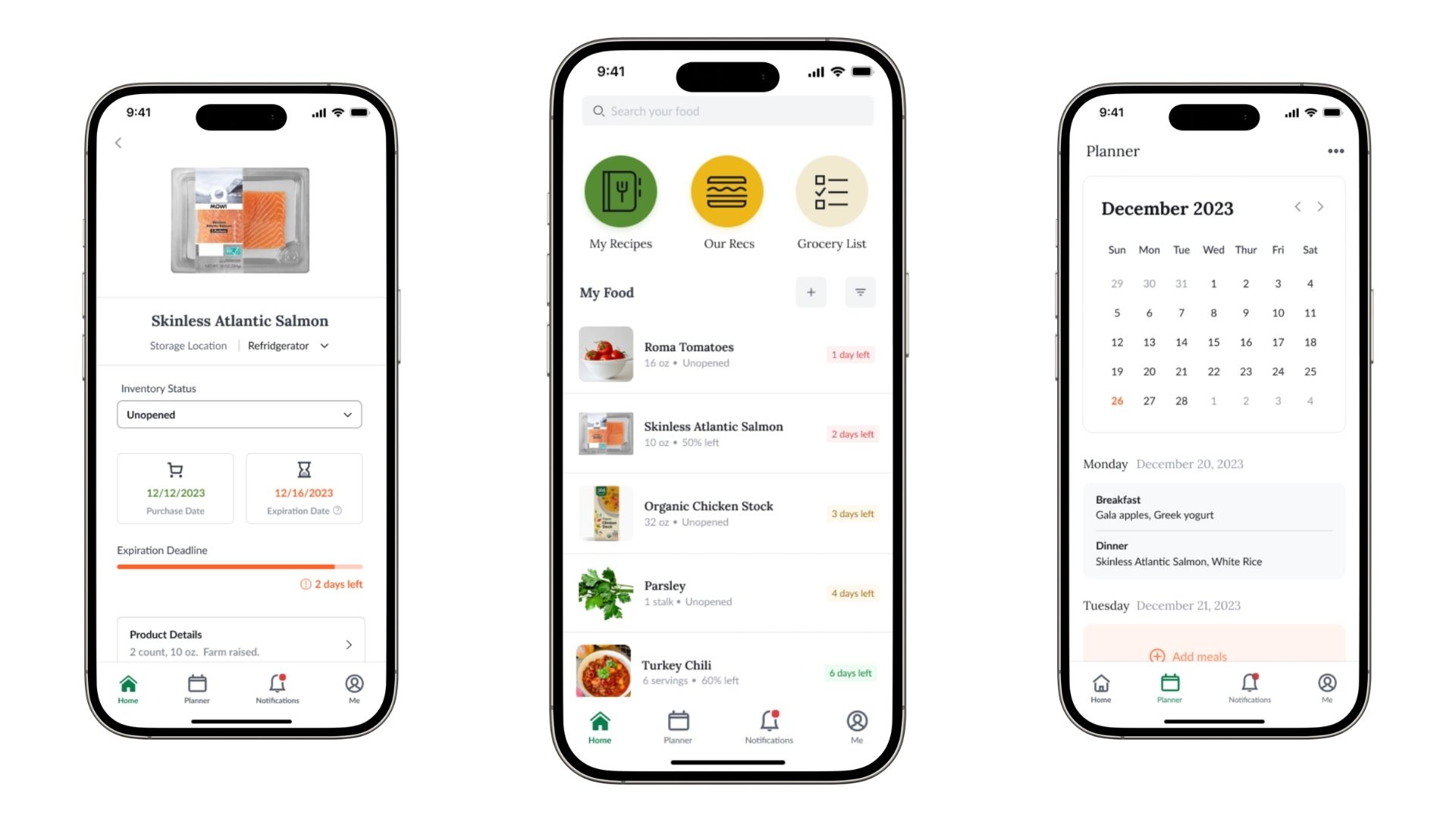
  • A calendar section lets users plan meals for the week ahead using items nearing expiration, paired with a recipe book to store go-to recipes, turning inventory visibility into an actionable plan

Persona journey mapping

Success metrics I would track

As an educational project without post-launch data, here's what I would track to measure whether these design decisions actually changed behavior:

Reduction in self reported food waste

I'd track self-reported food waste via a 30/60/90-day to see whether visibility into freshness actually changed food disposal rate.

Weekly active use of the calendar and recipe features

I'd measure weekly active use of the calendar and inventory features to see whether users build proactive planning into their routine rather than reverting to reactive cleanouts.

Efficacy of expiration notifications

I'd track notification engagement (opened vs. dismissed) to gauge whether proactive alerts changed behavior or became noise users ignored.

Final Prototype